
Alors que les réglementations sur la construction écologique et les environnements intérieurs sains deviennent des priorités mondiales, les émissions de VOC (composés organiques volatils) sont devenues l’un des indicateurs environnementaux les plus importants pour les revêtements de sol en PVC.
Pour les maîtres d’ouvrage, architectes et entrepreneurs travaillant sur des hôpitaux, écoles, laboratoires et sites sportifs, les revêtements de sol en PVC à faibles émissions ne sont plus seulement un avantage marketing : ils constituent souvent une exigence obligatoire du projet.
Cependant, les exigences relatives aux VOC varient considérablement selon les pays et les régions. Différents marchés adoptent différentes méthodes d’essai, limites d’émission et systèmes de certification.
Comprendre ces différences peut aider les fabricants, distributeurs et entrepreneurs de projets à sélectionner les bonnes certifications et à améliorer l’accès aux projets internationaux.
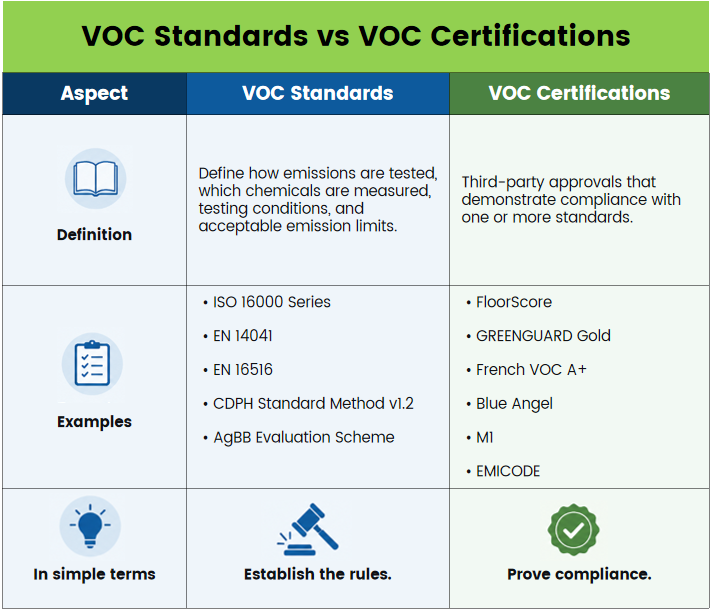
Avant de comparer les exigences mondiales, il est important de comprendre la différence entre une norme VOC et une certification VOC.
Les normes définissent :
· La manière dont les émissions sont testées
· Les substances chimiques mesurées
· Les conditions d’essai
· Les limites d’émission acceptables
Exemples :
· Série ISO 16000
· EN 14041
· EN 16516
· Méthode standard CDPH v1.2
· Schéma d’évaluation AgBB
Les certifications sont des approbations tierces qui démontrent la conformité à une ou plusieurs normes.
Exemples :
· FloorScore
· GREENGUARD Gold
· VOC français A+
· Ange bleu
· M1
· EMICODE
En termes simples, les normes établissent les règles, tandis que les certifications prouvent la conformité.
La série ISO 16000 est le cadre international le plus largement reconnu pour les tests de qualité de l'air intérieur.
Elle fournit des méthodes normalisées pour :
· Les essais en chambre environnementale
· L'échantillonnage des COV
· L'analyse chimique
· La mesure du formaldéhyde
La plupart des certifications COV utilisées dans l'industrie des revêtements de sol en PVC sont basées sur les méthodologies d'essai ISO 16000.
Bien que l'ISO 16000 elle-même ne soit pas une certification, elle sert de fondement technique à de nombreux programmes nationaux et régionaux.
Pour les fabricants exportant des revêtements de sol en PVC dans le monde entier, comprendre l'ISO 16000 est essentiel car elle constitue la base des tests COV à l'échelle mondiale.
Plusieurs certifications COV ont acquis une reconnaissance mondiale et sont fréquemment citées dans les programmes de construction écologique et les grands projets de construction.
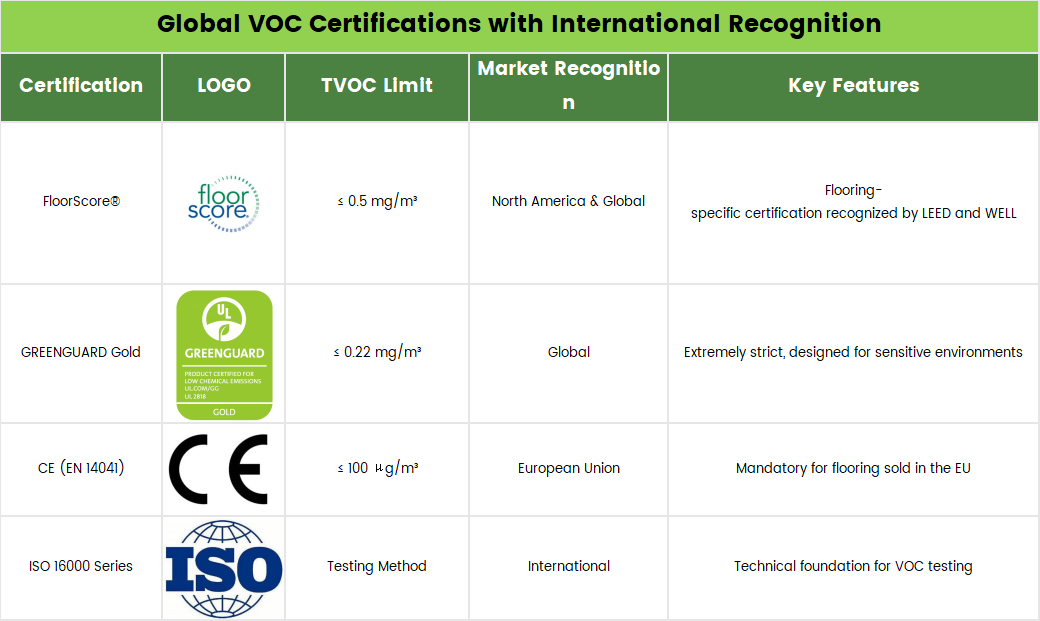
Pour les fabricants fournissant des revêtements de sol en PVC pour des projets hospitaliers, l'obtention des certifications FloorScore ou GREENGUARD Gold peut améliorer considérablement la compétitivité lors des appels d'offres.
Vous trouverez ci-dessous une présentation des normes ou certifications COV par différentes régions et différents pays.
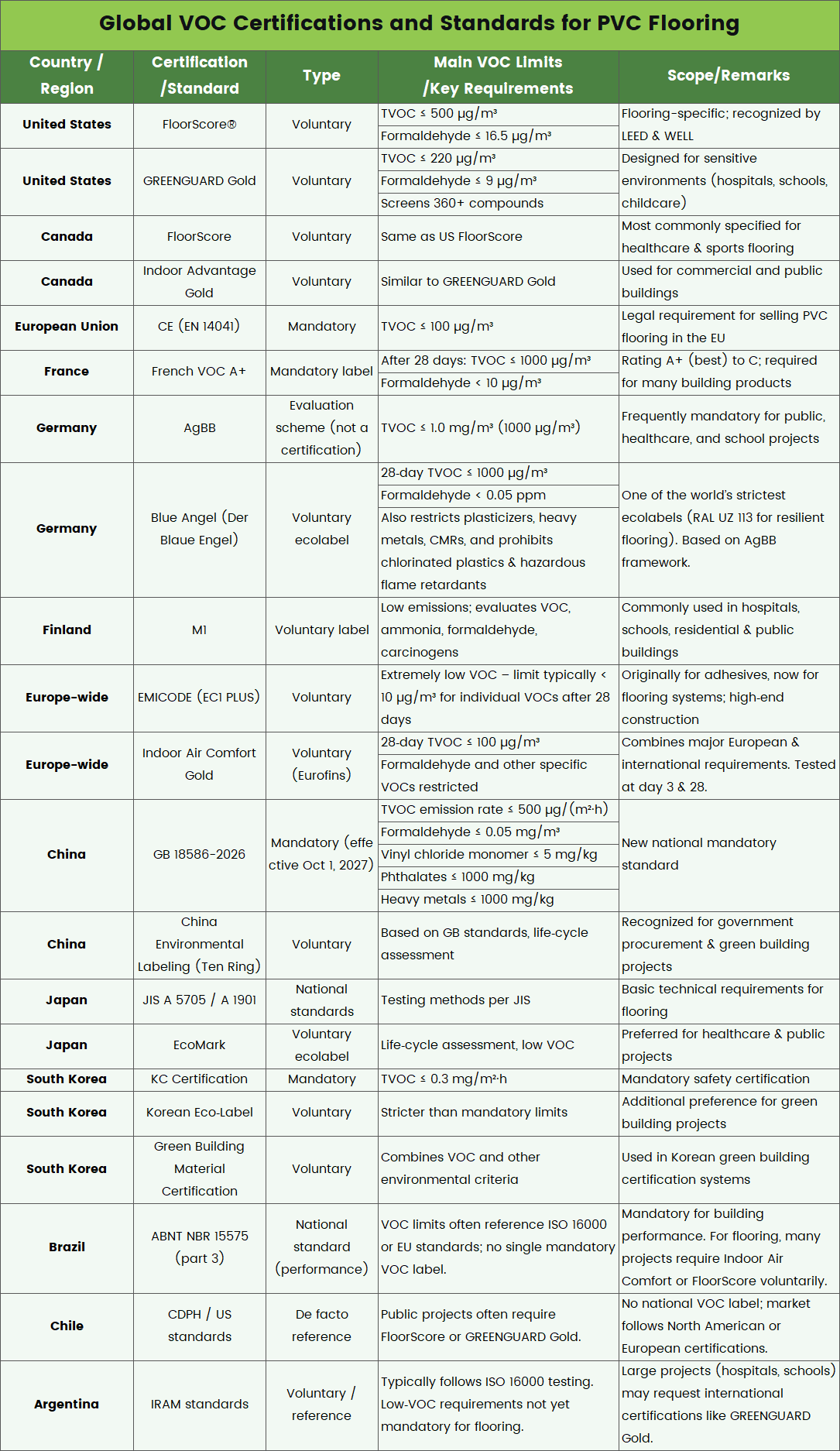
Pour une comparaison détaillée des normes et certifications COV par région, veuillez consulter le tableau complet à la fin de cet article.
FloorScore est l'une des certifications COV les plus largement reconnues pour les produits de revêtement de sol résilients.
Développée selon la méthode standard v1.2 du California Department of Public Health (CDPH), elle évalue les émissions de COV provenant de :
· Revêtements de sol en PVC
· Carreaux de vinyle de luxe (LVT)
· Revêtements de sol SPC
· Adhésifs pour revêtements de sol
· Sous-couches
FloorScore est fréquemment exigée pour :
· Revêtements de sol commerciaux en PVC
· Revêtements de sol pour établissements de santé
· Établissements d’enseignement
· Bâtiments publics
· Revêtements de sol sportifs en PVC
Comme il est spécifique aux revêtements de sol, FloorScore est souvent la certification minimale de COV attendue pour les grands projets en Amérique du Nord.
GREENGUARD Gold est largement considéré comme l’une des certifications de COV les plus strictes disponibles.
Pour les revêtements de sol en PVC destinés aux projets hospitaliers, GREENGUARD Gold est devenu l’une des certifications les plus demandées, car elle met l’accent sur la protection des populations sensibles telles que les enfants, les personnes âgées et les patients.
De nombreux consultants en revêtements de sol pour établissements de santé considèrent désormais GREENGUARD Gold comme une certification de référence lors de la sélection de revêtements de sol hospitaliers en PVC.
Le Canada suit généralement le cadre CDPH et reconnaît des certifications telles que :
· FloorScore
· Indoor Advantage Gold
· CRI Green Label Plus
Pour les projets de revêtements de sol en PVC pour établissements de santé et de revêtements de sol sportifs en PVC, FloorScore reste la certification la plus couramment spécifiée.
L’Europe combine des réglementations obligatoires avec plusieurs systèmes de certification volontaires.
Cela crée à la fois des opportunités et des défis pour les fabricants de revêtements de sol en PVC.
Contrairement à la plupart des certifications de COV, le marquage CE est obligatoire.
Tout revêtement de sol en PVC vendu au sein de l’Union européenne doit respecter les exigences de la norme EN 14041.
Exigence clé concernant les COV :
· TVOC ≤ 100 μg/m³
Sans conformité CE, les revêtements de sol en PVC ne peuvent pas entrer légalement sur le marché européen.
Pour les exportateurs, le CE n’est pas une option — c’est une condition préalable.
La France a introduit l’un des systèmes d’étiquetage des émissions les plus visibles en Europe.
Les produits sont classés comme suit :
· A+, A, B, C
A+ représente le niveau le plus élevé de performance en matière de qualité de l’air intérieur.
Les exigences comprennent :
· TVOC ≤ 1000 μg/m³ après 28 jours
· Formaldéhyde
L’étiquetage français A+ est obligatoire pour de nombreux produits de construction vendus en France.
Pour les revêtements de sol en PVC destinés aux projets hospitaliers, la certification A+ est souvent attendue même lorsqu’elle n’est pas explicitement exigée.
AgBB n’est pas une certification mais un système d’évaluation.
Cependant, il est largement considéré comme l’un des cadres d’évaluation des COV les plus stricts d’Europe.
AgBB évalue :
· Les émissions totales de COV
· Les composés dangereux individuels
· Les substances cancérogènes
· Les émissions à long terme
Exigence typique :
· TVOC ≤ 1,0 mg/m³
Pour les revêtements de sol destinés aux établissements de santé, aux infrastructures publiques et aux projets éducatifs en Allemagne, la conformité AgBB est fréquemment obligatoire.
De nombreux architectes européens considèrent les revêtements de sol en PVC conformes à AgBB comme une solution haut de gamme.
L’écolabel environnemental allemand Ange Bleu est considéré comme l’un des écolabels les plus exigeants au monde.
Au-delà des émissions de COV, il évalue également :
· Les plastifiants
· Les métaux lourds
· Le formaldéhyde
· La durabilité du produit
Pour les fabricants souhaitant positionner leur revêtement de sol en PVC comme un produit écologique haut de gamme, la certification Ange Bleu représente une valeur importante sur le marché.
L'étiquette finlandaise M1 met l'accent sur la qualité de l'air intérieur et les faibles émissions.
En plus des limites de COV, elle évalue :
· Ammoniac
· Formaldéhyde
· Composés cancérigènes
Les revêtements de sol en PVC certifiés M1 sont couramment utilisés dans :
· Hôpitaux
· Écoles
· Développements résidentiels
· Bâtiments publics
Initialement développé pour les adhésifs, EMICODE est de plus en plus appliqué aux systèmes de revêtement de sol.
La classification la plus élevée :
· EC1 PLUS
représente des émissions de COV extrêmement faibles et est souvent utilisé dans les projets de construction haut de gamme.
La Chine introduit des réglementations environnementales plus strictes pour les matériaux de revêtement de sol.
La nouvelle norme obligatoire :
GB 18586-2026
entrera en vigueur le 1er octobre 2027.
Les principales limites comprennent :
Pour les achats gouvernementaux et les projets de construction écologique, la certification chinoise d'étiquetage environnemental (certification des dix anneaux) reste l'un des écolabels les plus reconnus.
Les principales normes japonaises comprennent :
· JIS A 5705
· JIS A 1901
La certification EcoMark est largement reconnue et évalue les produits tout au long de leur cycle de vie.
Pour les revêtements de sol destinés aux établissements de santé et les projets publics, les revêtements de sol en PVC certifiés EcoMark bénéficient souvent d'une préférence supplémentaire.
La Corée du Sud exige :
· Certification KC
Exigence typique en matière de COV :
· TVOC ≤ 0,3 mg/m²·h
Les certifications volontaires supplémentaires comprennent :
· Écolabel coréen
· Certification des matériaux de construction écologiques
La certification COV n’est pas seulement importante pour les établissements de santé.
Elle devient de plus en plus importante pour les projets de revêtements de sol de badminton et de revêtements de sol sportifs intérieurs.
Les athlètes inhalent considérablement plus d’air pendant l’exercice que les occupants ordinaires des bâtiments.
Par conséquent, la qualité de l’air intérieur a un impact direct sur :
· Les performances sportives
· Le confort des utilisateurs
· La santé à long terme
Pour les revêtements de sol de terrains de badminton professionnels, les spécifications des projets demandent de plus en plus :
· FloorScore
· GREENGUARD Gold
· Indoor Air Comfort Gold
Ces certifications permettent de démontrer que les revêtements de sol de badminton et les revêtements de sol sportifs en PVC répondent aux attentes modernes en matière de qualité de l’air intérieur.
Pour les projets internationaux de terrains de badminton, les produits de revêtement de sol certifiés à faible teneur en COV bénéficient souvent d’un avantage concurrentiel lors des appels d’offres et des achats.
Les établissements de santé imposent généralement les exigences les plus strictes en matière de qualité de l’air intérieur.
Pour les revêtements de sol en PVC destinés aux environnements hospitaliers, le portefeuille de certifications le plus compétitif comprend :
Pour les revêtements de sol hospitaliers en PVC, les certifications sont de plus en plus considérées comme des indicateurs de la qualité du produit, de la sécurité des patients et de la conformité réglementaire.
Alors que la demande pour des environnements intérieurs plus sains continue de croître, les revêtements de sol en PVC certifiés, les revêtements de sol hospitaliers en PVC et les solutions de revêtement de sol pour badminton deviendront de plus en plus le choix privilégié des architectes, des entrepreneurs et des maîtres d’ouvrage dans le monde entier, La conformité aux normes COV est devenue un facteur essentiel de réussite des projets.
Le tableau suivant présente les normes et certifications COV dans différentes régions et différents pays.

Ajouter : No.5 Huaqing Intelligent Park, Huishan District, Wuxi, Jiangsu, China
Please read on, stay posted, subscribe, and we welcome you to tell us what you think.


droits d\'auteur © 2026 WUXI TEFA DECORATION MATERIAL CO., LTD. Tous droits réservés.
Plan du site | Blog | Xml | Privacy Policy
 Réseau pris en charge
 français
 English
 español
 português
 العربية