L’électricité statique peut sembler inoffensive, mais dans la fabrication électronique, les laboratoires, les salles blanches et les centres de données, même une petite décharge électrostatique peut endommager des composants sensibles, interrompre les opérations ou créer des problèmes de qualité coûteux.
Dans de nombreuses industries, l’électricité statique n’est pas seulement un petit désagrément. Elle peut interférer avec les équipements sensibles, endommager les composants électroniques, affecter la stabilité de la production ou créer des risques dans les environnements contrôlés.
C’est pourquoi le revêtement de sol en vinyle ESD est largement utilisé dans la fabrication électronique, les laboratoires, les salles blanches, les zones d’équipements médicaux, les centres de données, les salles de serveurs et autres espaces sensibles à l’électricité statique.
Mais le revêtement de sol ESD est souvent mal compris.
Certains acheteurs demandent simplement un « revêtement de sol antistatique », tandis que d’autres pensent que l’installation d’un seul type de sol en vinyle suffit à résoudre tous les problèmes de contrôle de l’électricité statique.
En réalité, le revêtement de sol en vinyle ESD n’est pas seulement un produit. Il fait partie d’un système complet de revêtement de sol.
Chez FARFLY, nous fournissons des revêtements de sol en vinyle ESD avec un adhésif conducteur assorti, des feuilles de cuivre, des cordons de soudure, des accessoires d’installation, des données techniques et un accompagnement de projet afin d’aider les clients à construire une solution de revêtement de sol de contrôle de l’électricité statique plus fiable.
Qu’est-ce qu’un revêtement de sol en vinyle ESD ?
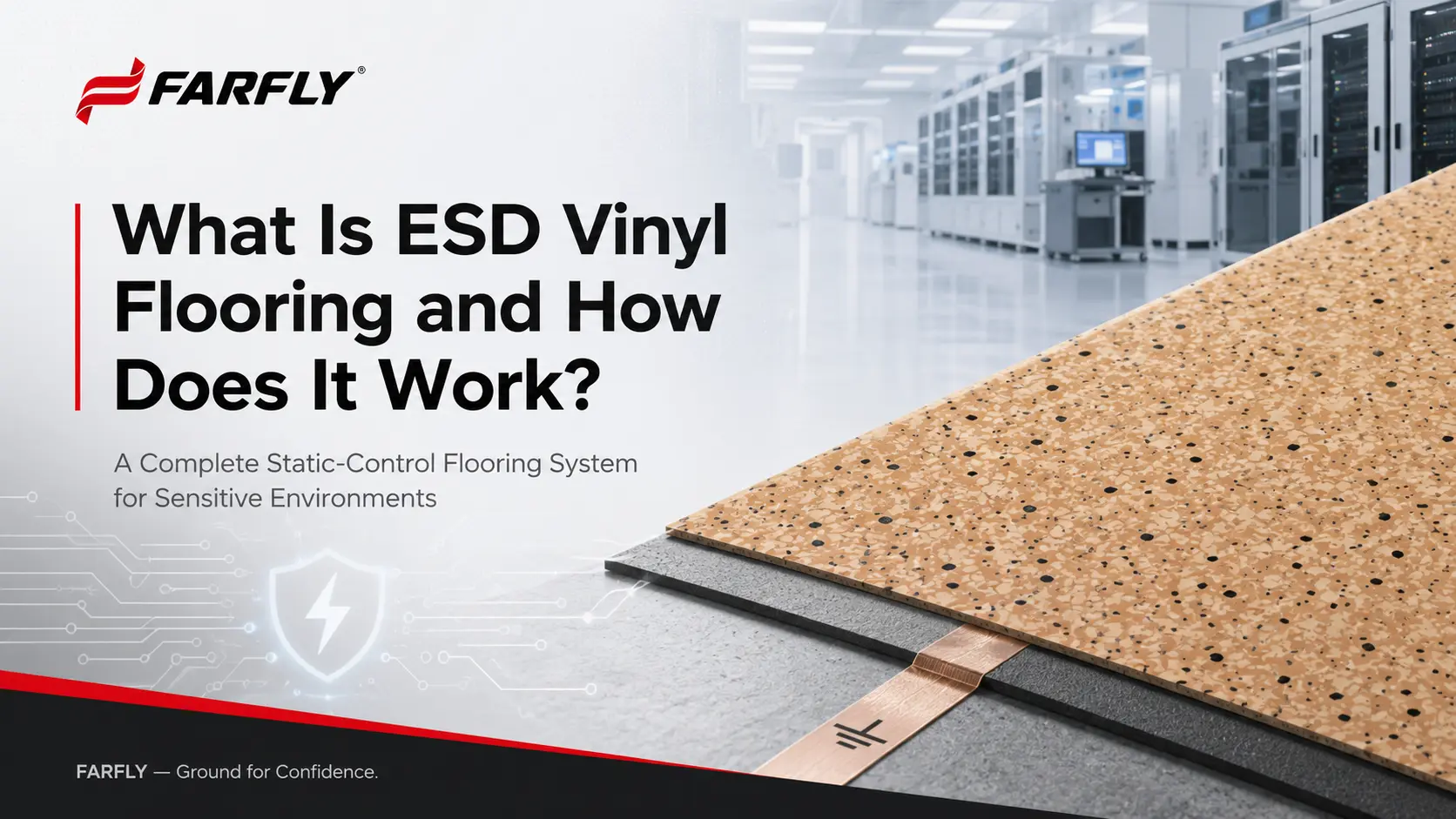
Le revêtement de sol en vinyle ESD est un matériau de revêtement de sol résilient conçu pour contrôler les charges électrostatiques.
Comparé au revêtement de sol en vinyle standard, le revêtement de sol en vinyle ESD contient des composants conducteurs ou dissipateurs d’électricité statique qui permettent aux charges électriques de circuler à travers le revêtement de sol de manière contrôlée.
Il est communément appelé :
-
Revêtement de sol en vinyle ESD
-
Revêtement de sol en vinyle conducteur
-
Revêtement de sol en vinyle dissipateur d’électricité statique
-
Revêtement de sol en vinyle antistatique
-
Cependant, ces appellations ne signifient pas toujours la même chose.
« Conducteur », « dissipateur d’électricité statique » et « antistatique » peuvent représenter différentes plages de résistance et différents niveaux de performance ESD. Pour cette raison, les acheteurs ne doivent pas se fier uniquement au nom du produit. Le choix correct doit être basé sur les exigences techniques du projet, la plage de résistance, la conception de la mise à la terre, le système d’installation et les normes d’essai applicables.
Pourquoi l’électricité statique est-elle un problème ?
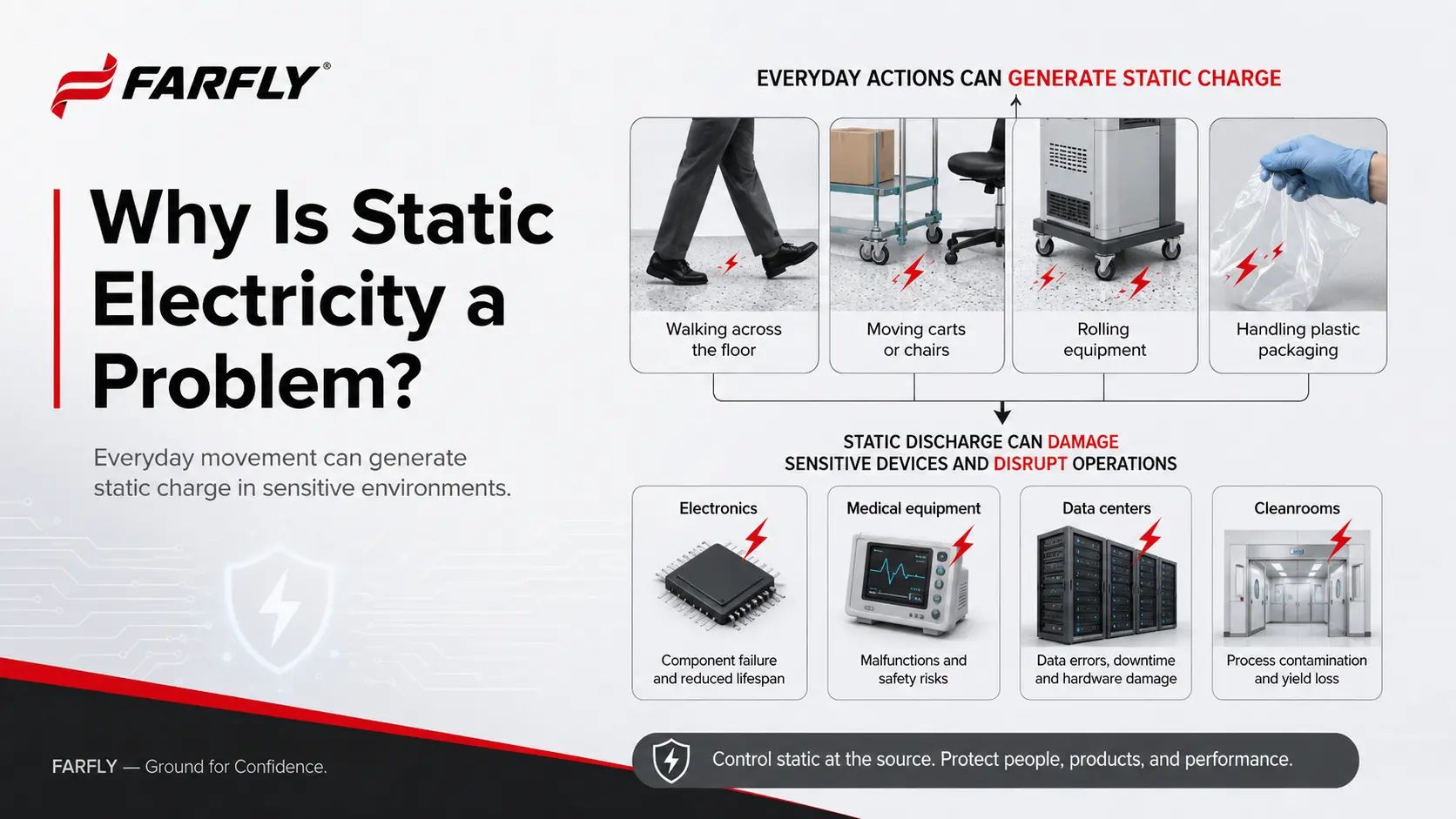
L’électricité statique est généralement générée lorsque deux matériaux entrent en contact puis se séparent. Ce phénomène est appelé effet triboélectrique.
Dans les environnements de travail quotidiens, des charges statiques peuvent être produites par de nombreuses activités normales, telles que :
-
Marcher sur le sol
-
Déplacer des chariots ou des chaises
-
Faire rouler des équipements dans une pièce
-
Manipuler des emballages en plastique
-
Retirer des films de protection
-
Porter des vêtements synthétiques
-
Travailler dans des conditions de faible humidité
Une personne peut accumuler une charge statique simplement en marchant. Lorsque cette personne touche un objet conducteur, une machine ou un composant électronique, la charge peut se décharger soudainement.
Parfois, les personnes peuvent ressentir cette décharge. Parfois, elles ne le peuvent pas.
Mais même si la tension est inférieure au niveau perceptible par l’être humain, elle peut encore être suffisamment élevée pour endommager des appareils électroniques sensibles. Dans certains cas, le composant tombe immédiatement en panne. Dans d’autres cas, les dommages sont cachés et réduisent seulement la fiabilité ou la durée de vie du produit.
C’est pourquoi le contrôle de l’électricité statique est important dans l’électronique, les équipements médicaux, les laboratoires, les centres de données et les environnements de fabrication de précision.
Comment fonctionne le revêtement de sol en vinyle ESD ?
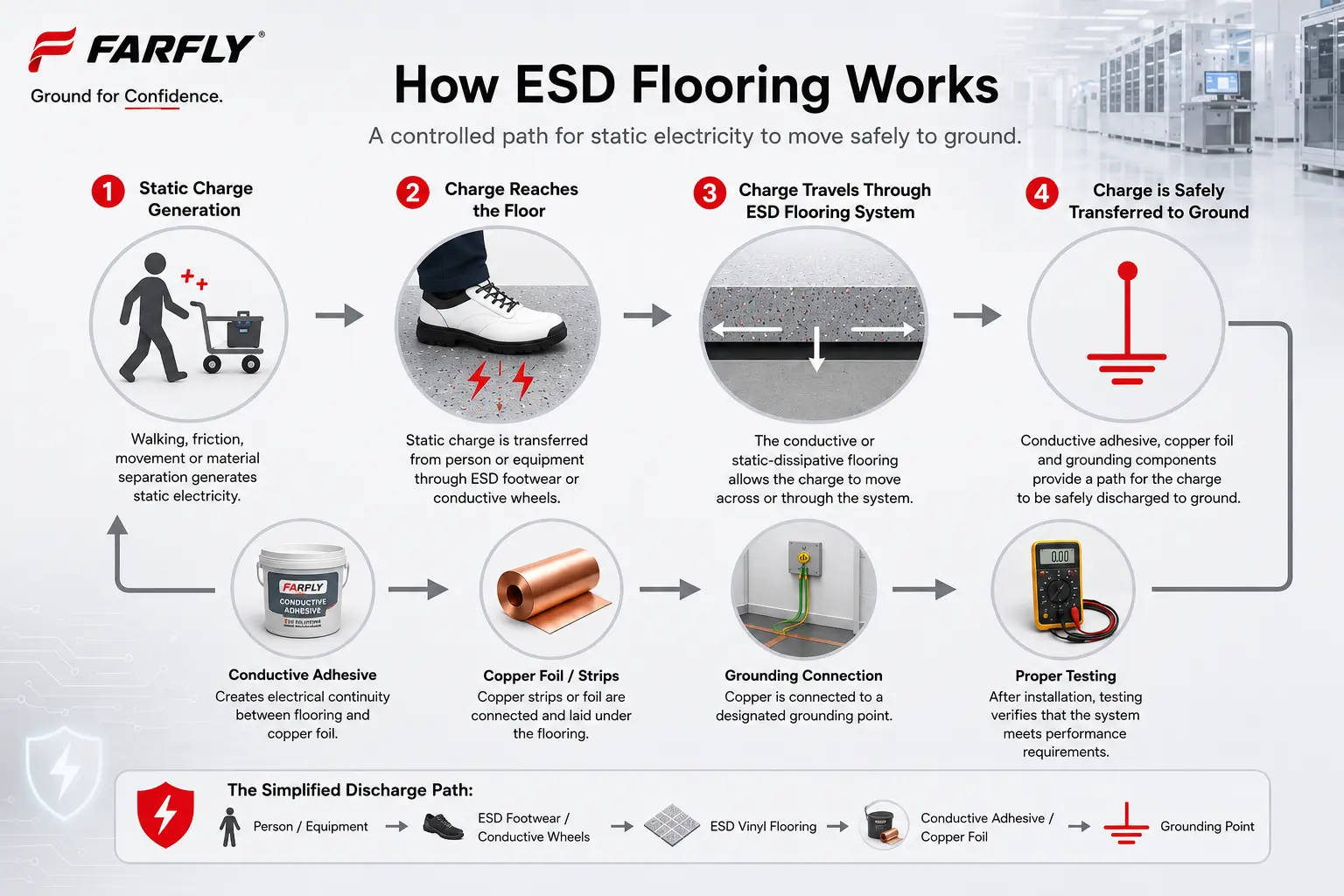
Le revêtement de sol en vinyle ESD fonctionne en créant un chemin contrôlé permettant à l’électricité statique de se déplacer des personnes, des chariots ou des équipements vers le système de mise à la terre de l’installation.
Un chemin de décharge simplifié est :
Personne ou équipement → chaussures ESD ou roues conductrices → revêtement de sol en vinyle ESD → adhésif conducteur ou feuille de cuivre → point de mise à la terre
Ce processus comprend généralement quatre étapes.
Premièrement, l’électricité statique est générée par la marche, le mouvement, la friction ou la séparation de matériaux.
Deuxièmement, la charge atteint le sol par l’intermédiaire de chaussures ESD, de roues conductrices, de chariots ou d’équipements.
Troisièmement, la charge se déplace à travers le système de revêtement de sol conducteur ou dissipatif statique.
Enfin, la charge est transférée vers un point de mise à la terre désigné par l'intermédiaire d'un adhésif conducteur, d'une feuille de cuivre et de composants de mise à la terre.
L'objectif n'est pas nécessairement d'éliminer instantanément chaque charge statique. Le véritable but est d'empêcher l'accumulation dangereuse de charges et de réduire le risque de décharge électrostatique incontrôlée.
Revêtement de sol conducteur vs. revêtement de sol dissipatif statique
Dans les projets de revêtement de sol ESD, deux catégories courantes sont les revêtements de sol conducteurs et les revêtements de sol dissipatifs statiques.
Revêtement de sol en vinyle conducteurprésente une résistance électrique plus faible et permet aux charges de se déplacer plus rapidement vers la terre. Il est souvent utilisé dans les environnements où des performances de contrôle statique plus strictes sont requises.
Revêtement de sol en vinyle dissipatif statiquelibère les charges à un rythme plus contrôlé. Il est couramment utilisé dans les zones d'assemblage électronique, les laboratoires, les salles blanches et autres espaces protégés contre les ESD.
Le choix approprié dépend des exigences du projet.
Pour les projets de revêtement de sol ESD FARFLY, nous recommandons de confirmer la plage de résistance requise, la méthode de test, l'application de la pièce, le système de chaussures, la configuration de mise à la terre et le plan de maintenance avant de sélectionner le produit final.
Une solution de revêtement de sol ESD adaptée doit être choisie en fonction de l'ensemble de l'environnement, et pas uniquement selon l'apparence du produit ou son prix.
Que comprend un système complet de revêtement de sol ESD ?
L'installation seule d'un revêtement de sol en vinyle ESD ne crée pas automatiquement une zone complète protégée contre les ESD.
Un système complet de revêtement de sol ESD comprend généralement plusieurs éléments.
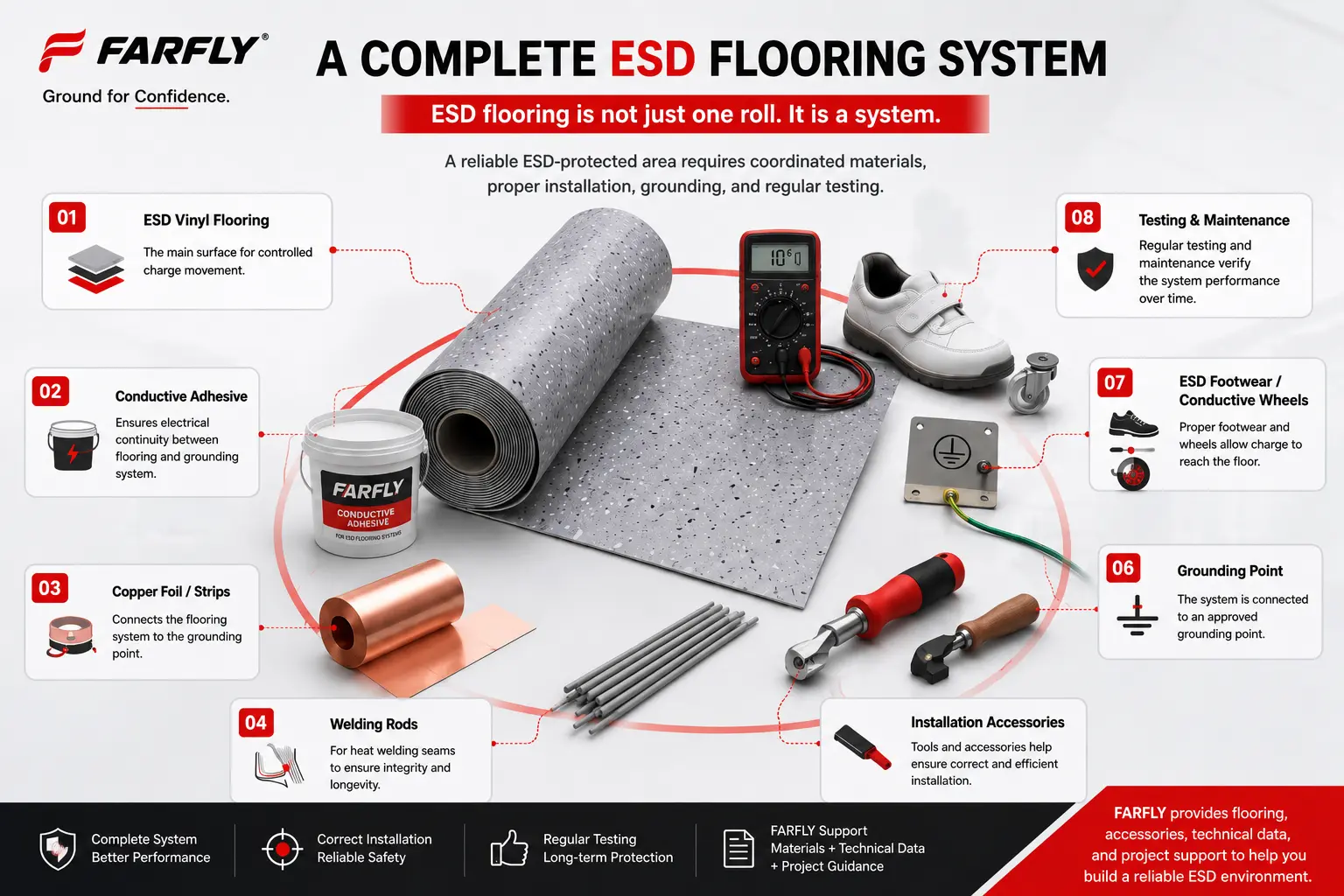
- Revêtement de sol en vinyle ESD
Le revêtement de sol fournit la surface principale pour le déplacement contrôlé des charges. Il doit répondre aux performances électriques requises et être adapté à l'environnement d'application.
-
Adhésif conducteur
L'adhésif conducteur aide à créer une continuité électrique entre le revêtement de sol et le système de mise à la terre. L'utilisation d'un adhésif ordinaire au lieu d'un adhésif conducteur peut interrompre le chemin de décharge et affecter les performances du système.
-
Feuille de cuivre ou bandes de mise à la terre en cuivre
La feuille de cuivre est généralement installée sous le revêtement de sol et reliée au point de mise à la terre. La configuration dépend de la taille de la pièce, du type de produit et des exigences du projet.
-
Cordons de soudure et accessoires d'installation
Pour les revêtements de sol en rouleau, les cordons de soudure aident à créer des joints étanches et à améliorer la finition globale de l'installation. D'autres accessoires peuvent également être nécessaires selon le projet.
-
Chaussures ESD et roues conductrices
Le revêtement de sol ESD doit fonctionner conjointement avec des chaussures et des roues d'équipement adaptées. Des chaussures isolantes ordinaires ou des roues en caoutchouc standard peuvent bloquer le chemin électrique.
-
Mise à la terre et tests
Le système de revêtement de sol doit être connecté à un point de mise à la terre approuvé et testé après l'installation. Les tests permettent de confirmer si le système terminé répond aux performances requises.
Chez FARFLY, nous ne fournissons pas uniquement des rouleaux de revêtement de sol. Nous pouvons fournir un ensemble complet de matériaux, comprenant un revêtement de sol en vinyle ESD, un adhésif conducteur, une feuille de cuivre, des cordons de soudure, des accessoires et des conseils d'installation pour l'utilisation dans les projets.
Où le revêtement de sol en vinyle ESD est-il utilisé ?
Le revêtement de sol en vinyle ESD convient à de nombreux environnements sensibles à l'électricité statique, notamment :
-
Usines de fabrication électronique
-
Zones de production de PCB et SMT
-
Installations de semi-conducteurs
-
Salles blanches
-
Laboratoires
-
Fabrication de dispositifs médicaux
-
Zones de production pharmaceutique
-
Centres de données et salles de serveurs
-
Installations de télécommunications
-
Usines aérospatiales et d'ingénierie de précision
-
Centres de recherche et développement
-
Salles de contrôle
-
Salles de tomodensitométrie hospitalières et zones liées aux équipements
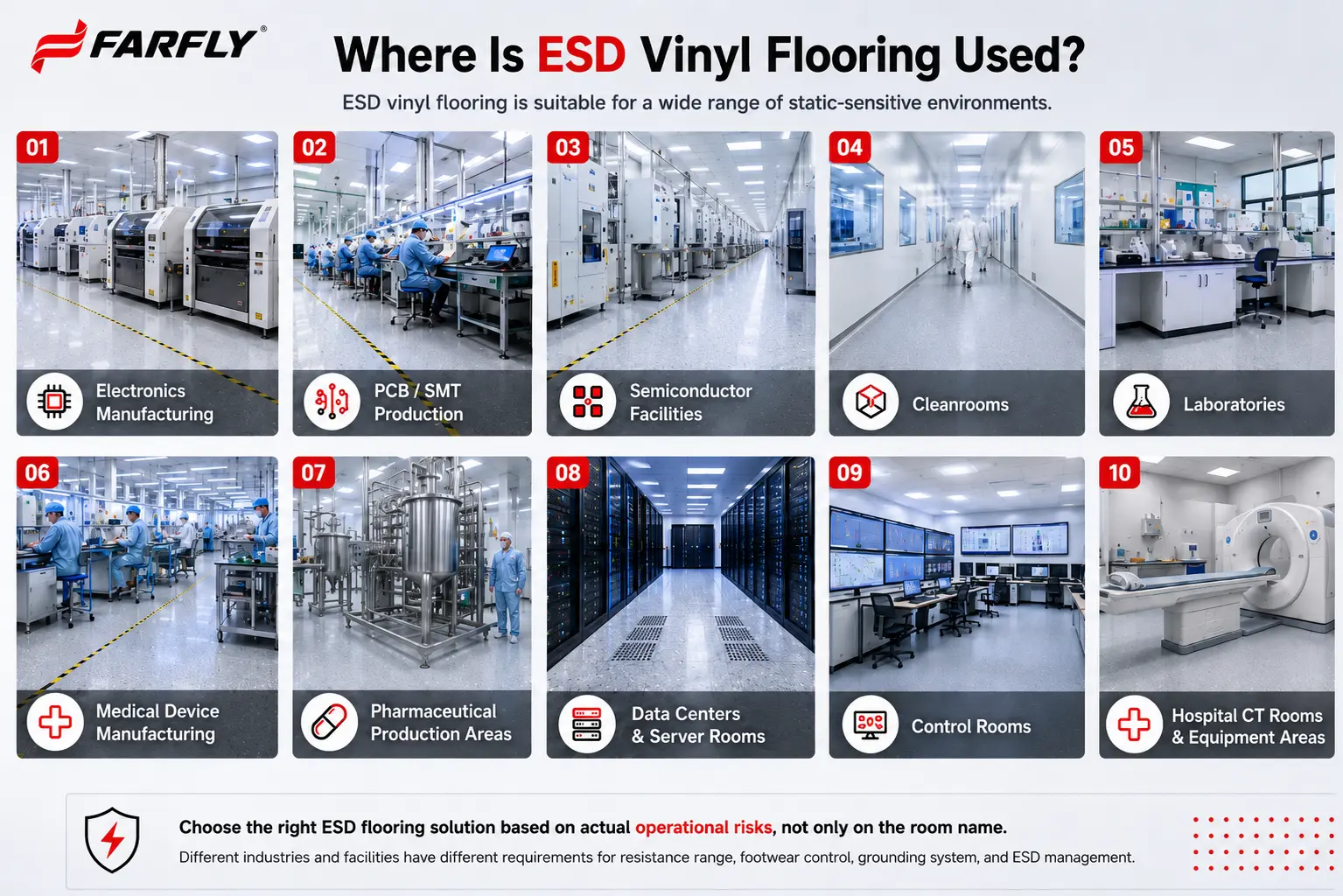
La spécification du revêtement de sol doit être basée sur les risques opérationnels réels, et pas uniquement sur le nom de la pièce.
Par exemple, deux usines électroniques peuvent nécessiter des systèmes de revêtement de sol ESD différents selon les composants fabriqués, les équipements utilisés, le contrôle des chaussures, le système de mise à la terre et les exigences internes de gestion ESD.
Pourquoi choisir les revêtements de sol vinyle ESD FARFLY ?
FARFLY se concentre sur des solutions de revêtements de sol résilients basées sur des projets pour les établissements de santé, les sites sportifs, les salles blanches, les installations commerciales et autres environnements à hautes exigences.
Pour les projets de revêtement de sol ESD, notre valeur ne se limite pas à la fourniture de produits.
Nous accompagnons les clients avec :
-
Options de revêtement de sol vinyle ESD
-
Solutions de revêtement de sol conducteur et dissipateur d'électricité statique
-
Adhésif conducteur adapté
-
Feuille de cuivre et baguettes de soudure
-
Accessoires d'installation
-
Fiches techniques
-
Rapports d'essai et assistance documentaire
-
Assistance à la communication de projet
-
Emballage d'exportation et coordination de l'approvisionnement
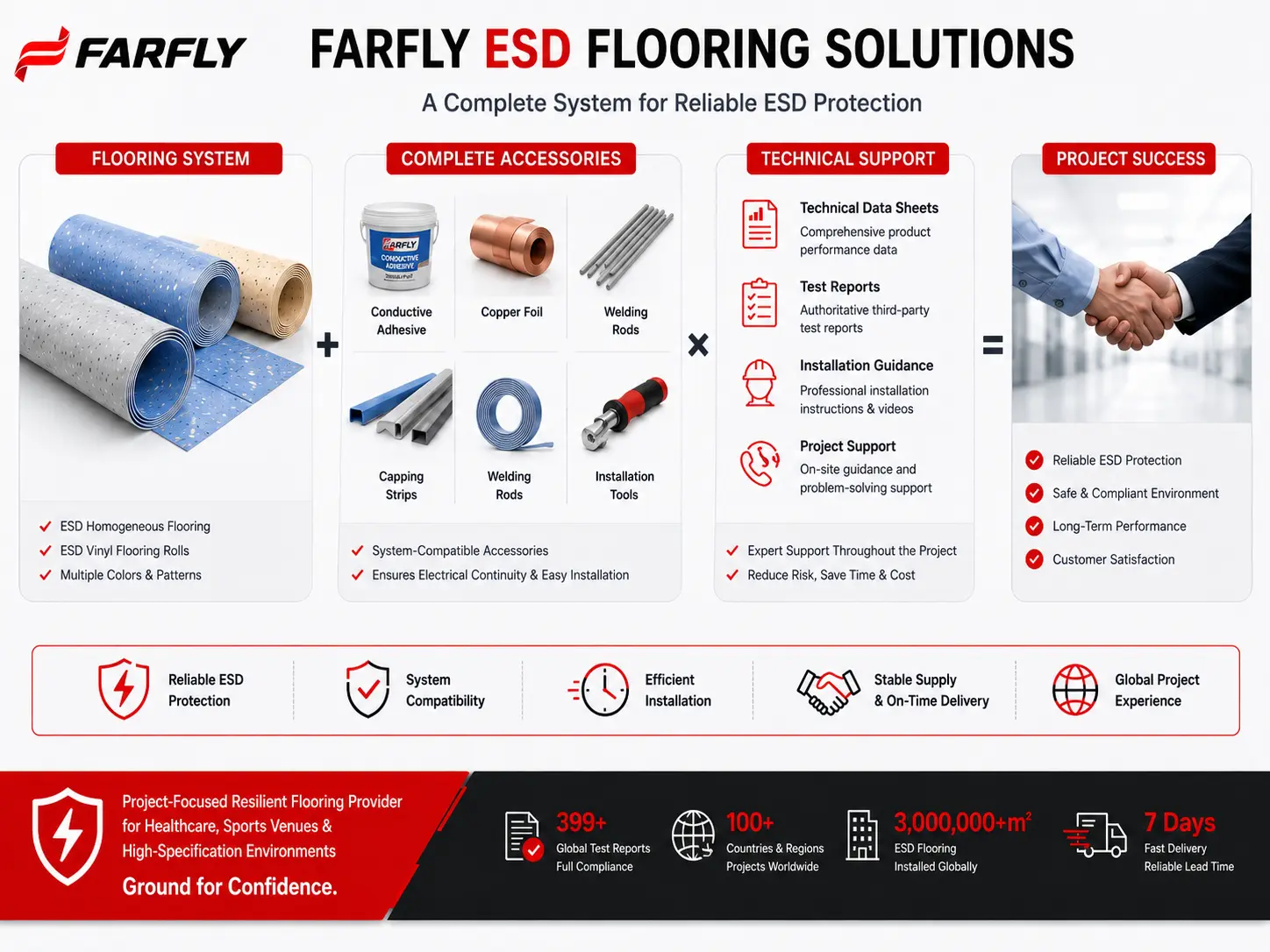
Pour les distributeurs, les entrepreneurs et les chefs de projet, cela contribue à réduire le risque d'accessoires manquants, de mauvais choix de produits ou d'installation incomplète du système.
Dans les projets de revêtement de sol ESD, un prix bas du matériau ne suffit pas. Le système complet doit être correct.
Facteurs influençant les performances des revêtements de sol ESD
Les performances d'un sol ESD fini peuvent être différentes de celles d'un petit échantillon de revêtement de sol.
Plusieurs facteurs peuvent influencer le résultat final.
État du support
Le support doit être propre, sec, plat et structurellement solide. L'humidité, la poussière, les fissures, la contamination ou les irrégularités peuvent affecter l'adhérence et les performances à long terme.
Matériaux d'installation
L'adhésif conducteur et la feuille de cuivre doivent être installés correctement. Si le mauvais adhésif est utilisé, le chemin de mise à la terre peut être interrompu.
Conception de la mise à la terre
Le sol doit être connecté à un système de mise à la terre approprié. Une mauvaise mise à la terre peut empêcher le revêtement de sol de fonctionner comme prévu.
Chaussures et équipements
Un revêtement de sol ESD ne peut pas évacuer efficacement l'électricité statique du personnel s'il porte des chaussures isolantes. Les chaises, chariots et équipements mobiles peuvent également nécessiter des roulettes conductrices ou dissipatrices d'électricité statique.
Nettoyage et entretien
Certaines cires, certains revêtements ou résidus de nettoyage peuvent créer une couche isolante sur le sol. Les produits d'entretien doivent être compatibles avec les revêtements de sol ESD.
Tests périodiques
Les performances ESD peuvent évoluer avec le temps en raison de l'usure, de la contamination, des dommages ou de problèmes d'entretien. Des tests réguliers permettent de vérifier le maintien des performances.
Comment le revêtement de sol vinyle ESD est-il testé ?
Les tests sont importants avant et après l'installation.
Les éléments de test courants peuvent inclure :
-
Résistance point à point
-
Résistance entre le sol et la terre
-
Résistance du système personnel-chaussures-sol
-
Test de tension de marche
-
Contrôles de continuité de mise à la terre
-
Inspection visuelle des joints et des zones endommagées
Les tests du produit et les tests du système installé ne sont pas identiques.
Un échantillon de revêtement de sol peut répondre aux données requises en laboratoire, mais la pièce terminée nécessite toujours une installation correcte, une mise à la terre, un contrôle des chaussures et une maintenance appropriés pour obtenir des performances fiables.
C’est pourquoi FARFLY recommande de considérer le revêtement de sol ESD comme un système complet, et non simplement comme un seul rouleau de matériau.
Comment entretenir un revêtement de sol en vinyle ESD
Un programme d’entretien adapté contribue à protéger à la fois l’apparence et les performances électriques du sol.
Les pratiques recommandées comprennent :
-
Éliminer régulièrement la poussière et les débris détachés
-
Nettoyer rapidement les déversements
-
Utiliser des produits de nettoyage approuvés
-
Éviter les cires ou revêtements isolants sauf approbation spécifique
-
Inspecter les joints, les bords et les zones endommagées
-
Vérifier périodiquement les connexions de mise à la terre
-
Tester les performances électriques à des intervalles planifiés
-
Conserver des enregistrements du nettoyage, des réparations et des tests
Les équipes de maintenance doivent comprendre qu’un sol ESD est une partie fonctionnelle du système de contrôle de l’électricité statique de l’installation, et pas seulement une surface de sol décorative.
Idées reçues courantes sur les revêtements de sol en vinyle ESD
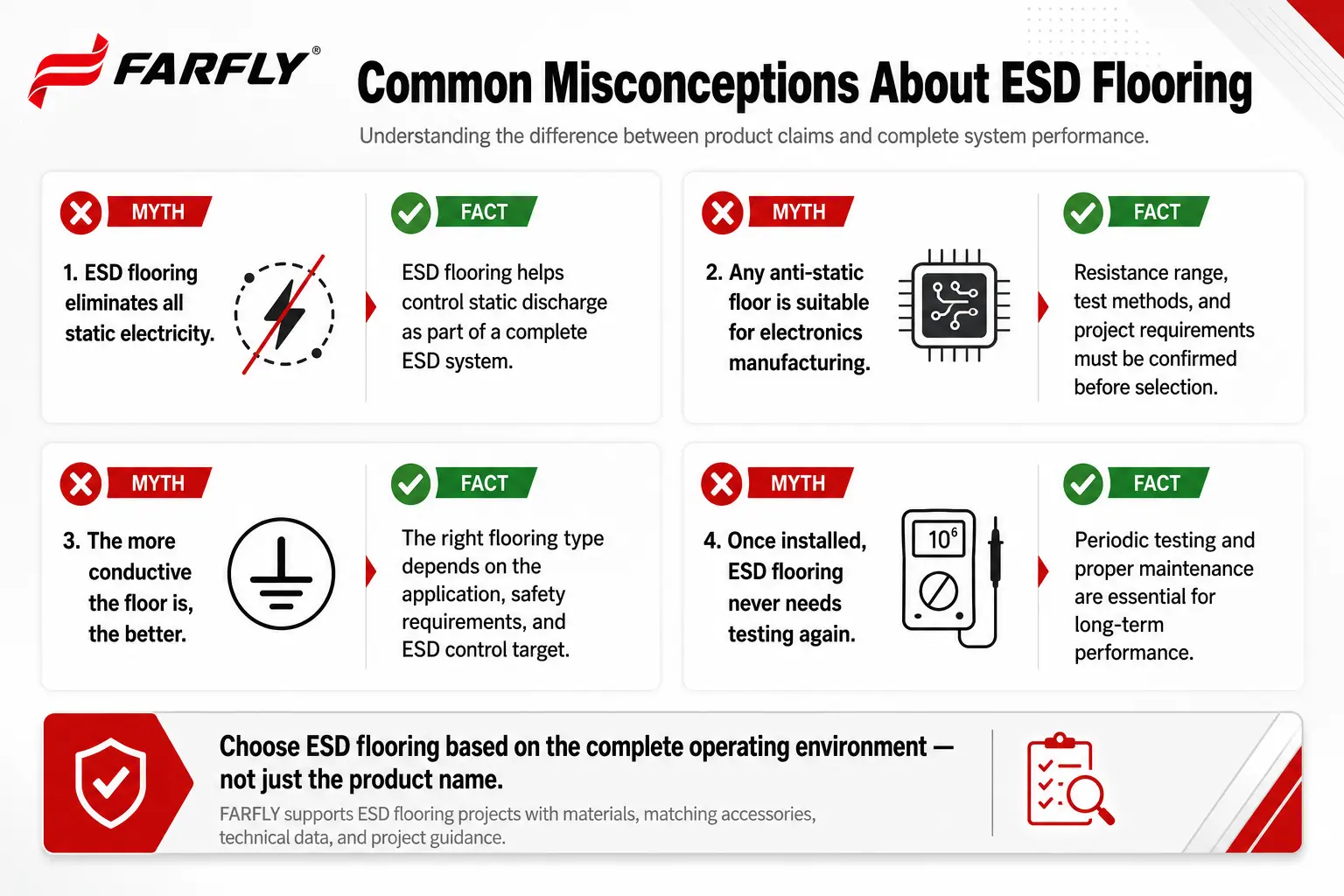
« Le revêtement de sol ESD élimine toute l’électricité statique. »
Le revêtement de sol ESD aide à contrôler la charge statique, mais il n’élimine pas toutes les sources de génération d’électricité statique. Il doit fonctionner avec les chaussures, la mise à la terre, le contrôle de l’humidité, la gestion des équipements et les procédures d’exploitation.
« Tout sol antistatique convient à la fabrication électronique. »
Pas nécessairement. Le terme « antistatique » seul ne confirme pas la plage de résistance du produit, ses performances en tension de marche ou sa conformité aux exigences du projet.
« Plus le sol est conducteur, mieux c’est. »
Une résistance plus faible n’est pas toujours meilleure pour toutes les applications. Le système doit fournir un contrôle statique adapté tout en répondant également aux exigences de sécurité et d’exploitation.
« Une fois installé, un revêtement de sol ESD n’a plus jamais besoin d’être testé. »
Les performances ESD peuvent être affectées par la saleté, l’usure, les produits de nettoyage, les dommages ou les problèmes de mise à la terre. Une vérification périodique est importante.
Comment choisir le bon revêtement de sol en vinyle ESD
Avant de choisir un système de revêtement de sol ESD, prenez en compte ces questions :
-
Quelle norme ESD ou quelle spécification de projet doit être respectée ?
-
Un revêtement de sol conducteur ou dissipateur d’électricité statique est-il requis ?
-
Quelle plage de résistance est requise ?
-
La zone utilisera-t-elle des chaussures ESD, des chaises ou des chariots ?
-
Le projet concerne-t-il une nouvelle installation ou une rénovation ?
-
Quel est l’état du sous-plancher ?
-
La zone nécessite-t-elle une résistance aux salles blanches, aux produits chimiques, aux taches ou au glissement ?
-
Quels accessoires d’installation sont nécessaires ?
-
Le fournisseur peut-il fournir des données techniques et une documentation de test ?
-
Le fournisseur peut-il accompagner la communication du projet et fournir des conseils d’installation ?
Un fournisseur qualifié doit évaluer l'application avant de recommander un produit.
Conclusion
Le revêtement de sol en vinyle ESD fournit un chemin contrôlé permettant à l'électricité statique de se déplacer des personnes, des chariots et des équipements vers un point de mise à la terre désigné. Il aide à réduire l'accumulation de charges statiques et le risque de décharge électrostatique incontrôlée.
Cependant, une protection ESD efficace ne dépend pas uniquement du revêtement de sol.
Elle nécessite la bonne combinaison de revêtement de sol en vinyle ESD, d'adhésif conducteur, de feuille de cuivre, de mise à la terre, de chaussures compatibles, d'une installation appropriée, d'un entretien régulier et de tests périodiques.
FARFLY fournit des solutions de revêtement de sol ESD pour des projets internationaux, avec des matériaux de revêtement de sol, des accessoires assortis, de la documentation technique et un accompagnement de projet.
Si vous planifiez un projet de revêtement de sol ESD pour la fabrication électronique, des laboratoires, des salles blanches, des centres de données, des zones d'équipements médicaux ou d'autres environnements contrôlés, FARFLY peut vous aider à comparer les options adaptées et à préparer une solution complète de système de revêtement de sol.
FARFLY — Un sol pour la confiance.




 Réseau pris en charge
 français
 English
 español
 português
 العربية